Warren Zaïre-Emery's Training Secrets: The Midfield Machine Behind France's Bright Football Future
The 4 Habits Behind the Youngest Player in PSG History — Now in a World Cup Semifinal at 20
What does Warren Zaïre-Emery's training look like?
How does someone go from being dropped from the French national team at 19 to playing in a World Cup semifinal a year later?
A Sneak Peek into Warren's 4 Secrets:
- Ten years inside the PSG academy — the technical foundation most players never get
- A confidence crisis at 19 that nearly derailed everything — and how he came back
- The physical development that turned a teenager into a box-to-box engine
- A team mentality so complete he'd play goalkeeper if asked
Keep Reading to Learn More …
Warren Zaïre-Emery was born in Montreuil, just outside Paris, on March 8, 2006.
Sixteen years and 151 days later, on August 6, 2022, he made his professional debut for Paris Saint-Germain.
The youngest player in the club's history.
A record that had stood since 1970.
By the end of his first season, he had become the club's youngest goalscorer, youngest UEFA Champions League player, and a Ligue 1 champion—all before his 17th birthday.
Then came the setbacks.
Injuries disrupted his momentum. His form dipped. In October 2025, after one of the toughest stretches of his young career, he was left out of France's senior squad and sent back to the under-21s.
Many wondered if his rapid rise had stalled.
He responded the only way he knew how: by going back to work.
Less than a year later, Zaïre-Emery had fought his way back into Didier Deschamps' plans and was once again wearing the French shirt on football's biggest stage, the 2026 World Cup.
He's only 20 years old, yet he's already become one of the faces of France's next generation.
Zaïre-Emery's journey has already included record-breaking debuts, championship titles, setbacks, and a return to the world's biggest stage. And yet, it still feels like the beginning.
Here's what we can learn from how he's gotten this far, and what may carry him even further.
Secret 1: Ten years in the PSG academy — the technical foundation most players never get
Zaïre-Emery didn't arrive at PSG as a finished product. Rather, he arrived as a child.
He joined the Paris Saint-Germain youth academy at just ten years old, beginning a decade-long technical education that would eventually make him the youngest player in the club's recorded history. The PSG academy, known as the Camp des Loges, runs one of the most structured youth development programmes in European football.
Technical work, positional intelligence, physical conditioning, recovery protocols, and the likes. The whole structure of an elite footballer is built there, one year at a time.
By 16 he was playing in the Champions League. Not as a nervous teenager trying to survive. As a player who knew exactly what to do with the ball under pressure because he'd been trained to think that way for a decade.
His technical profile as a midfielder is described by PSG coaching staff as unusually complete for his age.
Effective at winning the ball. Comfortable receiving it in tight spaces. Good enough with both feet that Didier Deschamps deployed him at right-back for more than half of his PSG appearances in 2025-26 without losing anything meaningful.
That versatility doesn't happen by accident. It's the product of years of structured training that demanded technical competence before athletic development.
"It's a blast to be here. I'm enjoying every moment of every minute. No matter the position, I'll do my best to help the team."
— Warren Zaïre-Emery (World Cup 2026, ahead of France vs Senegal)
For anyone looking to build that kind of technical foundation outside an elite academy, one of the best investments is an agility ladder and cone set. These are staples of individual football training and are regularly used in technical sessions by professional clubs, including PSG.
They're inexpensive, easy to set up almost anywhere, and form the backbone of footwork, agility, and close-control development. Better yet, there are countless high-quality drills available online for free. It's important to use them regularly. Over time, those small, repeated improvements compound into noticeably sharper movement and ball control.
Secret 2: The confidence crisis at 19 — and the comeback that got him to the World Cup
In October 2025, Warren Zaïre-Emery was dropped from the French national team and sent back to the under-21s.
He was 19.
Twelve months earlier, he'd been one of the most exciting young midfielders in Europe. Then an ankle injury disrupted his season at PSG. He missed matches. The team changed while he was out. When he returned, the rhythm and confidence that had made him look so comfortable on the ball weren't quite there.
His own description of that period says more than any outside analysis could.
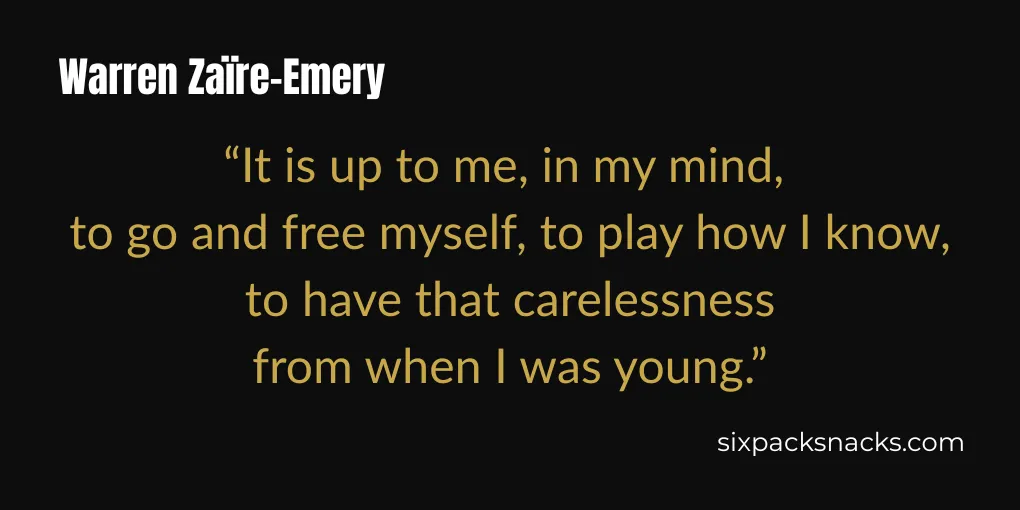
"I'm holding myself back. I know that I have the ability. Confidence is playing a bit of a part. It is up to me, in my mind, to go and free myself, to play how I know, to have that carelessness from when I was young. It will come back naturally."
— Warren Zaïre-Emery (October 2025, on being dropped from Les Bleus)
There's a level of honesty here that's rare for any professional athlete, let alone a teenager.
Some players blame the manager. Others blame the injury, bad luck, or a lack of opportunities. Zaïre-Emery didn't point the finger anywhere else. He admitted that the biggest obstacle was in his own head. More importantly, he believed it could be fixed.
That mindset shaped everything that followed.
He went back to the under-21s. He played regularly. The minutes added up. The rhythm returned.
"My goal is to regain confidence, enjoy playing, and reclaim the place I held two years ago. I will give my best, rebuild my confidence. I know what I have to do."
— Warren Zaïre-Emery (August 2025)
Within weeks, he was back with the senior national team.
By March 2026, he was wearing the captain's armband for PSG.
A few months later, he was selected for France's World Cup squad.
The confidence didn't come first.
The football did.
He kept training. He kept playing. Every match gave him another chance to trust himself again, until confidence stopped being something he was chasing and simply became a by-product of playing well.
"The France Under-21 team really did me good. The fact of playing and continuing to string together matches gave me rhythm. It gave me this power that I have in my legs, and it also did me good mentally. It allowed me to continue in this momentum and do what I love to do."
— Warren Zaïre-Emery (March 2026, on his return to form)
For anyone looking to build that same mindset deliberately, The Champion's Mind by Jim Afremow is one of the best books on sports psychology. After decades of working with Olympians, world champions, and professional athletes, Afremow reached a conclusion that mirrors Zaïre-Emery's comeback: confidence isn't something you wait to feel. It's built through preparation, repetition, and trusting your training.
One of the book's central themes is learning to perform with the same freedom and confidence you had before pressure and self-consciousness crept in (i.e. the very "carelessness" Zaïre-Emery said he was trying to rediscover).
The best athletes don't ignore the mental side of performance. They train it.
Two-time Olympic gold medalist freestyle skier Eileen Gu relies on visualization before competitions. Four-time Olympic champion swimmer Léon Marchand works with sports psychologists to prepare for the biggest races of his life. Two-time Olympic champion gymnast Carlos Yulo has spoken openly about how improving his mental well-being changed the way he competed and helped him arrive in Paris ready to win two Olympic gold medals.
The best athletes at the top of their game all know that body follows where the mind is willing to go.
Secret 3: The physical development that turned a teenager into a box-to-box engine
The physical profile of a box-to-box midfielder is one of the most demanding in football. You need to press aggressively, win duels, recover quickly, and then arrive in the opposition box with enough energy to finish.
Now, repeat that ninety times over ninety minutes, forty to fifty times a season.
Zaïre-Emery logged nearly 4,200 minutes across all competitions for PSG in 2025-26, featuring in more than 50 matches. At 20, that's not just talent, it's a body that has been built to handle the load.
PSG's physical development programme for young players runs on a structure of compound strength work, sprint conditioning, and neuromuscular training. The kind of programme that turns technical players into athletes who can back up their skill with physical output across a full season. The club's sports science department monitors every player's load, sleep, and recovery data continuously.
His physical attributes on the pitch are well documented. He's described consistently as powerful in duels for his size, effective at pressing, and tireless in his recovery runs.
The physical side isn't incidental to what he does. It's what allows the technical side to function under pressure for ninety minutes.
For athletes building the box-to-box engine Zaïre-Emery has developed, compound lower body strength is the foundation. Heavy resistance bands cover the hip and glute work that drives explosive movement and supports the repeated sprint capacity that midfield football demands.
For athletes trying to build the kind of box-to-box engine Warren Zaïre-Emery has developed, the foundation starts with lower-body strength.
An heavy resistance band set is a simple way to train the hips and glutes that drive explosive acceleration, quick changes of direction, and repeated sprints. These are the movements midfielders rely on every few minutes of a match.
The other piece is recovery and energy production.
Creatine monohydrate is one of the most researched supplements in sports nutrition, and it directly supports the high-intensity bursts football demands. Taking 3-5 grams daily helps replenish ATP, the energy system your muscles use for short, explosive efforts.
Think about the moments that decide games: the first step to win back possession, the sprint into the box in the 85th minute, or the recovery run after losing the ball. Those actions rely on repeated bursts of power, exactly where creatine is most useful.
The International Society of Sports Nutrition (ISSN) recognizes creatine monohydrate as the most effective supplement for improving high-intensity exercise capacity and increasing lean mass.
Research compiled by Examine.com also shows that creatine helps the body regenerate ATP faster during maximal efforts.
There may even be benefits beyond the pitch. Dr. Rhonda Patrick has discussed how creatine increases brain creatine stores, which may support cognitive performance and mental resilience during periods of stress.
The best type of creatine
Don't overcomplicate it.
Despite the endless marketing around creatine HCl, ethyl ester, and other variations, standard creatine monohydrate remains the best choice. It's the form with the most research behind it, and it's also the most affordable.
The supplement world loves new formulas. Creatine Monohydrate has stayed popular for one reason: it works.
The evidence is strong and the cost is low.
Secret 4: The team-first mentality — adapting to whatever the game demands
When asked before the World Cup about being used at right-back rather than his natural midfield position, Zaïre-Emery didn't complain. He didn't deflect. He said this:
"The coach came and asked me 'would you mind if I play you at left-back for a training match?' I replied to him with pleasure — he could even put me in goal if he wanted to."
— Warren Zaïre-Emery
That isn't a player playing politics. It's a player who has spent his entire life adapting to whatever the team needed. At PSG, when Achraf Hakimi was unavailable, he went to right-back. In the France squad, when he wasn't starting, he went to training and tried to make the players around him better.
"When I'm not playing, I try to be at my best in training so that the others perform well. If I don't play much, I'll push them to be even better."
— Warren Zaïre-Emery
On what makes France strong at this World Cup:
"Solidarity, because we are first and foremost a team, a family. We fight for each other — that's what will allow us to go far."
— Warren Zaïre-Emery
And on what he wants from the tournament:
"You've just got to take it all in, enjoy it — and win the World Cup for the country."
— Warren Zaïre-Emery
The adaptability that Zaïre-Emery demonstrates requires a physical readiness that doesn't switch off. You can't arrive cold when an opportunity appears. The players who respond best to unexpected demands are the ones who stay prepared long before their moment arrives.
That is the real lesson from Zaïre-Emery's team mentality. Elite players aren't defined only by their talent or the position they prefer to play. They're defined by their ability to help the team win, whatever the situation requires.
The best teammates become the most trusted players. And the most trusted players are the ones coaches turn to when everything is on the line.
The Takeaway
Warren Zaïre-Emery was the youngest player in PSG history at 16. He was dropped from the French national team at 19. At 20, He helped France make it all the way to the semifinals at the 2026 World Cup semifinals.
The record-setting teenager and the dropped, searching 19-year-old are the same person. What connects them isn't talent. Plenty of talented players disappear between those two points.
It's the specific response to difficulty: name what's wrong, do the work day-in and day-out to fix it, remain adaptable, and play with the same enjoyment that made it easy in the first place.
As we always say at Sixpack Snacks: if you want to be the best, practice the habits of the best.
Warren Zaïre-Emery's Essentials:
- Agility Ladder and Cone Set (the foundation of PSG's technical development sessions)
- The Champion's Mind by Jim Afremow (build the confidence that lets you play freely)
- Heavy Resistance Bands (build the hip and glute power box-to-box midfielders run on)
- Creatine Monohydrate (support the explosive, repeated-effort demands of midfield football)
Zaïre-Emery represents the future of French football, but the standard he is chasing was set by contemporary players like Kylian Mbappé. Explore the training secrets behind one of the world's most explosive forwards — from his speed development and recovery habits to the mentality that turned a teenage prospect into a global superstar.
Sources
- Wikipedia — Warren Zaïre-Emery
- Get French Football News — Deschamps Can Put Me in Goal If He Likes
- Paris Fans — Champions League, World Cup and Confidence: Zaïre-Emery Is Straightforward
- Yahoo Sports — Warren Zaïre-Emery on His France Demotion and World Cup Ambitions
- Tribuna — 'My Goal Is to Regain Confidence and Enjoy Playing Again'
- Yahoo Sports — Warren Zaïre-Emery: 'We Can Do Great Things'
- FIFA — World Cup Wonderkids: Warren Zaïre-Emery
- PSG Official — 'We Have Created a Real Squad, a Real Team'
- International Society of Sports Nutrition position stand: creatine supplementation and exercise
- Creatine - Health Benefits, Dosage, Safety, and Side Effects
- A Single Dose of Creatine Monohydrate Mitigates Sleep Deprivation's Harmful Effects on Brain Function and Cognition
- From Science to Dressing Room: Dietary Supplements for Elite Soccer Performance
- Effects of Creatine Supplementation on Brain Function and Health
- From mind to match: the impact of psychological skills intervention programs on football players' mental toughness, decision-making, and tactical skills
- Big Hitters: Important Factors Characterizing Team Effectiveness in Professional Sports
This article is for informational purposes. Always consult a qualified coach, nutritionist, or medical professional before starting a new training or nutrition program.