Carlos Yulo's Training Secrets: How the Philippines' Golden Boy Won Double Olympic Gold
The 4 Habits Behind the Man Who Left Home at 16, Crashed at Tokyo, and Came Back to Win Double Gold in Paris
What does Carlos Yulo's training routine look like?
How does a kid from Leveriza, Manila become the greatest gymnast Southeast Asia has ever produced?
A Sneak Peek into Carlos' 4 Training Secrets:
- Eight hours a day, six days a week — the volume built inside a Japanese gymnasium
- A redemption mindset forged from the worst night of his career
- Mental health as a third training session
- The pre-gold meal his nutritionist built around rice
Keep Reading to Learn More …
Carlos Edriel Yulo was just seven years old when his grandfather, Rodrigo Frisco, walked him into the Gymnastics Association of the Philippines.
The coaches spotted the raw talent almost instantly.
By 16, he faced a choice that would define his career. He traded his home in Leveriza, Manila, for the grueling gyms of Japan. Away from his friends and family. Submerged in an intense training regimen, under a coach he barely knew.
Three years later, the gamble paid off. He made the Philippines proud by becoming the first Filipino gymnast in history to capture World Championship gold.
Then everything went sideways.
At the Tokyo Olympics, the reigning world champion missed the cut for the floor final entirely. A day later, he came within 0.017 points of an Olympic medal on vault, finishing fourth by one of the cruelest margins imaginable.
Most athletes would have let that break them.
Yulo didn't.
At the Paris 2024 Olympics, he stormed back to the top of the podium with gold on floor. Less than 24 hours later, he did it again on vault.
Two Olympic gold medals.
The first Southeast Asian athlete to ever win two gold medals at a single Olympic Games.
After the medal ceremony, Yulo celebrated with a steak dinner and a trip to Disneyland Paris.
But the real story happened long before the medals. Here's what it took to get there.
Secret 1: Eight Hours a Day, Six Days a Week
Carlos Yulo's training schedule is relentless: up to eight hours a day in the gym, six days a week.Every session combines strength work, flexibility, skill practice, and endless repetitions until every routine becomes automatic under pressure.
Most athletes would burn out long before reaching that kind of workload. However, Yulo built his relentless stamina gradually over years that started when he was still a child.
The physical demand of artistic gymnastics is difficult to overstate.
A floor routine lasts just 60 to 70 seconds, but within that minute, gymnasts must combine tumbling passes, flips, twists, balance, power, strength, flexibility, and near-perfect execution. All judged down to the hundredth of a point.Every movement has to become automatic.
Strength-to-weight ratio sits at the center of everything. Gymnasts need enough explosive power to launch themselves several feet into the air while staying light enough to control every rotation before landing. That only comes from years of deliberate practice and an extraordinary amount of training volume.
Yulo built much of that foundation through bodyweight training on gymnastics equipment, including gymnastics rings.
Few pieces of equipment build functional upper-body and core strength as effectively. Because the rings move freely, every exercise forces the shoulders, chest, back, and core to stabilize throughout the movement. This is something fixed gym machines can't replicate.
Used consistently, they're one of the best tools for developing the pulling, pushing, and body control that gymnastics demands.
They look simple until you try them. Gymnastics rings are inexpensive, portable, and can be hung almost anywhere. Few pieces of equipment offer more value for building real upper-body strength.
Use them consistently for a few weeks, and you'll quickly feel the difference. Stronger shoulders, a more stable core, and noticeably better body control.
Gymnastics chalk is another staple. It may seem insignificant, but every gymnast relies on it. By absorbing sweat and improving grip, chalk reduces the risk of slipping when fractions of a second determine the outcome of a routine.
It isn't just useful for gymnastic rings workouts and other gymnastics training either. It's equally valuable for standard bar pull-ups, Olympic lifting, powerlifting, and even rock climbing, something elite solo climber Alex Honnald knows well.
Sometimes the difference between making the lift and dropping the bar comes down to grip alone. Keeping a block of chalk in your gym bag is a small habit that pays off whether you're training gymnastics, climbing, or chasing a new deadlift PR.
Yulo's commitment extended far beyond what happened inside the gym.
At just 16, he left the Philippines and moved to Japan to train under renowned coach Munehiro Kugimiya. He spent nearly a decade there, turning down scholarship offers from American universities so he could continue working with the coach he would later call his second father.
"The facilities in the Philippines are not for the high-level athletes."
— Carlos Yulo
That sacrifice of leaving home as a teenager, living through homesickness, setbacks, and years away from his family, became just as important to his success as the training itself. His career is a testament to what relentless work, humility, and a willingness to keep learning can achieve.
"I want to acquire knowledge from other athletes. Ask them, 'How to do these skills?' Ask coaches, 'Do you have any methods or strategies you can give me?' It really helped me a lot, not only in gymnastics, in life, as well."
— Carlos Yulo
Secret 2: The Redemption Mindset — From Tokyo's Lowest Point to Paris Double Gold
The image Yulo retweeted on August 2, 2021 — two days after his Tokyo qualifying disaster — was a graphic showing what spectators see versus what they don't. The visible part: athletes on a podium. The hidden part: blocks labeled desire, loneliness, honesty, sacrifice, hard work, joy.
He retweeted it without comment.
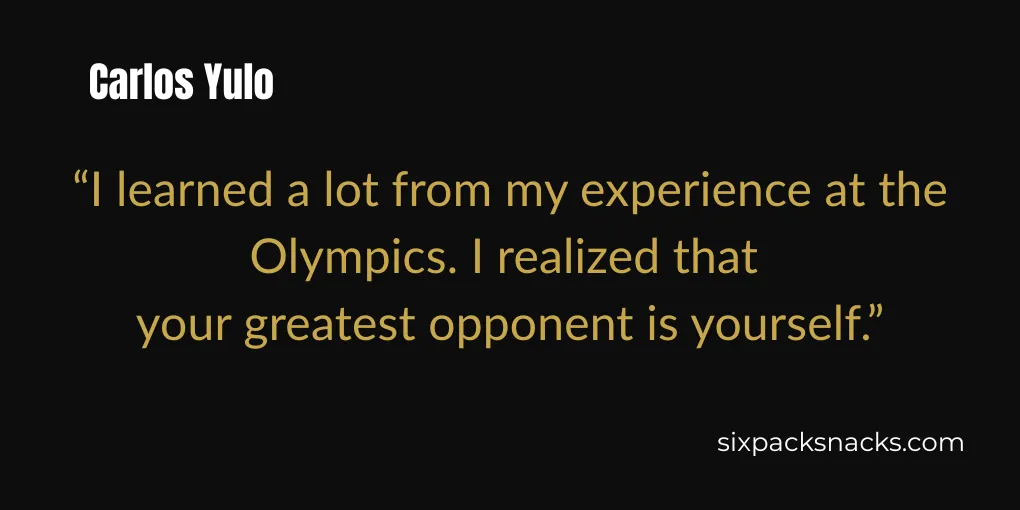
"I learned a lot from my experience at the [Tokyo] Olympics. I realised that your greatest opponent is yourself. If you don't focus on what you do, you are bound to finish last."
— Carlos Yulo
What he did next is what separates good athletes from great ones. Two months after Tokyo, he went to the World Championships in Kitakyushu and won gold on vault and silver on parallel bars. He didn't take time off. He acted on what he had learned.
"I try to correct the mistakes that I made in my mind so I will not commit them again."
— Carlos Yulo
The years between Tokyo and Paris were not smooth. A disappointing 2022 World Championships. A shocking 2023 qualifying performance that nearly cost him his Olympic quota. His split with Kugimiya, the coach he had trained under for nearly a decade, sent him back to the Philippines and then on a global training circuit: South Korea, Great Britain, and training alongside Team GB gymnasts at Lilleshall. Before, eventually heading to Paris.
"It's been a rollercoaster of everything that's happened to me. Those times made me stronger. I was able to meet the people that I needed to meet. [Those times] taught me values not only in gymnastics but also in my personal life. I'm so grateful to all the people who helped me."
— Carlos Yulo (post-Paris interview, Olympics.com)
The double gold in Paris was not the result of a smooth journey. It was the result of a specific kind of mental toughness: the ability to use failure as information rather than identity.
"Improving is tough and the process is not always enjoyable. Do not give up. Trust on the process, to the coach, and to God."
— Carlos Yulo
One practical way to adopt this mindset is by keeping a Training Journal. After each workout or competition, write down what went well, what didn't, and one thing you'll improve next time. It's a simple habit that turns setbacks into actionable feedback instead of discouragement.
Yulo didn't become an Olympic champion despite his failure in Tokyo. In many ways, he became one because of it.
The disappointment forced him to rebuild, refine his mindset, and come back stronger than before.
Secret 3: Mental Health as a Third Training Session
In the lead-up to Paris 2024, Carlos Yulo did something many athletes still resist. He invested in mental health support with the same seriousness he gave to physical conditioning.
Sports Occupational Therapist Lyn Hazel Calawod worked with Yulo on what she described as "all the mental, statistical, physical and spiritual work we had to do everyday to optimize Carlos for peak performance." This wasn't a counseling add-on. It was a central pillar of his Olympic preparation.
The honesty behind that decision is worth acknowledging. Yulo had spoken openly about his struggles with self-doubt after the 2022 World Championships:
"I get insecure about myself for the things I cannot do that others can. Sometimes, I focus on the things I cannot do that I cannot see my good sides anymore."
— Carlos Yulo
Most athletes are never that honest publicly. That honesty is also what allowed him to address the problem directly.
"I now have a better well-being. Whenever I perform, I have a better mindset. Even if I fall, win or lose, I'm grateful. I'm giving more attention to my mental health, my well-being. In that aspect, I've grown."
— Carlos Yulo
He credits his girlfriend Chloe San Jose as a significant part of his support system, saying she taught him to grow beyond gymnastics. "Before I only knew gymnastics," he said. "She is part of my motivation when I do gymnastics."
"I maintain a positive attitude. Nothing will happen if I get frustrated. I may have committed mistakes, but I learned a lot from them."
— Carlos Yulo
They are many lessons to take away from Yulo's mental health journey that he's publicly shared.
For one, we see the importance for athletes to decouple their identity from their output. When Yulo admitted, "Before I only knew gymnastics," he highlighted a trap many high performers fall into. If your entire self-worth is tied to your work, a single failure can break you.
Building a life and a support system outside your craft actually makes you more resilient within it.
We also often mistake mental toughness for ignoring self-doubt. Yulo proves the opposite. Acknowledging your insecurities is the only way to actively fix them.
The biggest practical takeaway here extends well beyond gymnastics. The athlete who addresses their mental performance with the same rigor they apply to physical training has a significant advantage over the one who ignores it. Yulo went into Paris 2024 with both sides of that equation covered.
Don't leave your mindset to chance. Actively training your mental resilience gives you a definitive edge over those who only focus on the technical work.
For more on using mental performance as a competitive advantage, read our breakdown of Eileen Gu's training secrets — the Olympic skier who credits neuroplasticity and deliberate mental rewiring for her gold medals.
Secret 4: The Pre-Gold Meal — Why Rice Won Two Olympic Medals
Before Carlos Yulo won his first gold medal in the floor exercise in Paris, he ate eggs, hamburger patties, and a substantial serving of rice.
His nutritionist, Jinkee Aro, built his competition-day meal plan around that specific combination. The philosophy behind it pushes back directly against one of the most persistent myths in sports nutrition.
Aro customizes Yulo's meals based on his activities for the day. The nutrition is the fine-tuning required for preparation, with the fundamentals provided by his gymnastics and conditioning coaches. This dynamic approach means that even small snacks and meals are carefully planned."Tell me now that carbohydrates are not important for elite-level athletes."
— Jinkee Aro, Carlos Yulo's nutritionist
The distinction between training-phase nutrition and competition-day nutrition is one that serious athletes often miss. Yulo's diet is different during training phases compared to competition days. This adaptability ensures that his nutritional needs are met precisely, optimising his physical capabilities.
On competition day, carbohydrates are the priority. Not because rice is magic. Because, glycogen is.
As sports dietitian Leigh Merotto puts it, "During moderate to high intensity exercise, our bodies rely on carbohydrates as our main fuel source." She also notes that rice is "a great source of easily digestible carbs, packed with nutrients to support the nutritional demands for athletes."
That's exactly why rice shows up so often on the plates of elite athletes. It's inexpensive, easy to digest, reliable, and one of the simplest ways to replenish the glycogen stores that power explosive performance.
The explosive, repeated efforts of a gymnastics competition depend on fast-access energy that only carbohydrates provide in sufficient quantity.
A low-carb approach before a competition drains the tank before the performance begins.
Yulo's nutrition is a reminder that performance doesn't come from chasing trendy diets or expensive supplements. It comes from consistently eating the right foods, adjusting them to the demands of your training, and mastering the basics. For him, that's often a simple plate of rice, quality protein, and vegetables rather than anything flashy.
A rice cooker is one of the simplest kitchen upgrades you can make if you're serious about training. It takes the guesswork out of meal prep, making it easy to have perfectly cooked rice ready whenever you need it.
Your biggest performance upgrade may not come from another supplement. It comes from consistently eating the meals that fuel your training.
Conclusion
Carlos Yulo's journey from Leveriza, Manila, to the top of the Olympic podium in Paris was anything but straightforward.
It was built on eight-hour training days in a foreign country, the courage to leave home at 16, a crushing Olympic disappointment at 21 that became the foundation of his comeback, and an unwavering commitment to improving every part of his craft—from his mindset to his nutrition.
Natural talent gave Yulo a head start. It wasn't what made him a double Olympic champion.
It happened because he treated failure as a lesson, trusted the process, and showed up every single day willing to do the work. That's what turned one of the most painful moments of his career into one of the greatest Olympic performances in Philippine history.
As we always say at Sixpack Snacks: if you want to be the best, practice the habits of the best.
Train Like Carlos Yulo
Gymnastics Rings (build functional upper-body strength and body control) Gymnastics Chalk (improve grip for rings, pull-ups, climbing, and heavy lifts) Rice Cooker (make fueling with quality carbohydrates effortless every day) Training Journal for Athletes (track your progress, reflect on every session, and turn mistakes into measurable improvement)
Sources
- Medical Channel Asia — Carlos Yulo's Olympic Diet: The Nutritional Secrets Behind His Success
- Olympics.com — Carlos Yulo: Aiming for Perfection by Learning from Failures
- Olympics.com — Carlos Yulo Exclusive: Fame, Fortune, and Hidilyn Diaz's Advice
- Olympics.com — Carlos Yulo: Shooting for the Stars at Paris 2024
- Olympics.com — Carlos Yulo Reflects on Tokyo: "Your Greatest Opponent Is Yourself"
- Inquirer Opinion — Greatness Knows No Bounds for Carlos Yulo
- The Beat Asia — What Carlos Yulo's Double Gold Win Can Teach Us About Supporting Athletes
- Heroic Mama — Carlos Yulo: Discover His Secret to Success
- Wikipedia — Carlos Yulo
- GutFit Nutrition — Rice: A Super Fuel Source for Athletes
This article is for informational purposes. Always consult a qualified coach, nutritionist, or medical professional before starting a new training or nutrition program.