Coco Gauff's Health Secrets: Diet, Mental Health, and the Training That Made Her a Grand Slam Champion at 19
The 4 Habits Behind the Woman Who Won the US Open at 19 and Beat Venus Williams at 15
What does Coco Gauff's daily routine look like?
How does someone ranked world No. 2 at 21, while publicly managing anxiety, panic attacks, and the expectations of an entire sport, stay on top?
A Sneak Peek into Coco's 4 Health Secrets:
- A non-restrictive diet built around protein, pineapple, and zero food guilt
- Mental health work she does openly, including through a panic attack mid-match
- A cross-training programme that includes beach volleyball and 400m sprints
- A one-word answer that defines her entire fitness philosophy
Keep Reading to Learn More …
In 2019, a 15-year-old Coco Gauff walked onto Centre Court at Wimbledon and defeated one of her childhood idols, Venus Williams. Overnight, she became the future of American tennis.
By 2023, she had won her first Grand Slam title at the US Open.
Then in 2025, she had added the French Open, climbed to World No. 2, and established herself as one of the most complete players in women's tennis.
Along the way, she became known for something else. Gauff has never tried to fit the mold of the perfectly polished superstar. Whether she's celebrating with homemade snacks, speaking candidly about the mental side of competition, or taking responsibility after difficult losses, she has remained unapologetically herself.
Cori "Coco" Gauff is only 21 years old, yet she's already one of the defining athletes of her generation.
Here's a closer look at the habits, routines, and mindset that have helped her get there.
Secret 1: The non-restrictive diet — protein, pineapple, and Chick-fil-A
When asked about how she fuels herself during long training sessions, Gauff's answer was not what most people expect from a professional athlete.
"I just go out there and rawdog it, to be honest. My hardest part is definitely fueling while I'm having those long practices because I don't feel really hungry."
— Coco Gauff (Business Insider)
That candour runs through everything she says about food. Her approach is balanced and practical. Breakfast is eggs with toast. A mid-morning snack after her first training session, which usually ends around 11am, is a hard-boiled egg.
"I always need protein. I take protein after practice, but to have it throughout the day on the go definitely helps a lot," she says.
Her main meals mostly consist of salads, lean chicken, and potatoes.
Dinner is always a protein, chicken or salmon, with vegetables. She rarely eats red meat, but "every now and then" she'll have a steak.And between meals, she keeps it simple.
She turns to fruit, which provides quick carbs for energy and aids muscle recovery. Her go-to is a fruit salad often containing pineapple, her favourite, along with grapes, honeydew, cantaloupe, or watermelon.The fruit isn't arbitrary. She uses it specifically as a stress tool on match days.
"Sometimes when you're stressed, your nervous system can cause you to produce more energy than you're probably used to. There are cases where people cramp, just due to stress. So I eat fruit to combat that."
— Coco Gauff
Despite her professional career, Gauff avoids strict eating habits. A philosophy her parents instilled to ensure she could still enjoy being a teenager. She loves Chick-fil-A, brownies, ice cream, and fast food.
Before Wimbledon 2025, she posted a food-hopping day out with a friend on Instagram: a sandwich, what looked like a matcha drink, a strawberry dipped in chocolate. "I luv food," she captioned it.Her love of pineapple eventually became a partnership. In 2025, Gauff teamed up with Naked Smoothies as their "Chief Smoothie Officer," launching her signature Protein Pineapple Orange Smoothie. It packs 20 grams of plant-based protein alongside real pineapple and orange juices, electrolytes from coconut water, vitamins B6 and B12, six grams of fiber, and no added sugar.
"Pineapple's my favorite. It has 20 grams of protein, which is important for me as an athlete. So it has all the things that I balance in my everyday life"
— Coco Gauff
If you want to try the same smoothie Gauff helped create, her Naked Protein Pineapple Orange Smoothie is an easy grab-and-go option. With 20 grams of plant-based protein, electrolytes from coconut water, and real fruit juice, it reflects the same balanced approach she takes toward nutrition: enough protein to support recovery, enough carbohydrates to fuel training, and nothing unnecessarily complicated.
If you'd rather make your own, Vitamix blenders are widely regarded as the gold standard for athletes and anyone serious about their nutrition. Consistently ranked among the best-performing blenders in independent testing, they effortlessly blend frozen fruit, protein powder, oats, Greek yogurt, and leafy greens into smooth, drinkable shakes.
A Vitamix blender is one of the highest-return kitchen investments you can make. The classic 5200 remains the benchmark for durability and performance, while the 7500 is another outstanding option, earning top marks for its exceptionally smooth blends, powerful ice crushing, and premium build quality.
Smoothies are one of the easiest ways to hit your protein, fruit, and calorie targets after training, especially when time or appetite is limited.
Blend frozen pineapple, Greek yogurt or protein powder, milk, and a banana in literally a couple of minutes, and you have a recovery shake that delivers high-quality protein alongside carbohydrates to replenish glycogen and vitamin C from pineapple to support normal immune function.
Pineapple also contains bromelain, a naturally occurring enzyme that has been studied for its potential anti-inflammatory effects and role in supporting recovery after strenuous exercise. It's no surprise why it's one of Gauff's favorite foods.
Secret 2: Mental health is part of performance, not separate from it
During the 2025 US Open, Coco Gauff experienced something many athletes quietly deal with but rarely admit publicly: a panic attack in the middle of competition.
She didn't hide it. She didn't soften the language. She called it what it was.
"I think it was a panic attack. I was trying to calm myself down and breathe in the moment."
— Coco Gauff (Tennis365)
She stepped away briefly, gathered herself, returned to the court, and finished the match.
The remarkable part wasn't that Gauff experienced anxiety. Even the best athletes in the world feel overwhelming pressure. The remarkable part was her willingness to speak about it openly, using the language of mental health rather than disguising it behind phrases like "I wasn't feeling my best" or "I got nervous.
"Mental health is invisible, but it's a very real issue"
— Coco Gauff (Tennis365)
That honesty reflects a larger philosophy Gauff has developed throughout her career: mental strength is not something you either have or don't have. It is something you train.
Before the 2024 Olympics, she spoke about actively working on mindfulness and learning how to control her attention under pressure:
"I've been trying to meditate more. Sometimes I'm impatient, so it's hard for me to sit still. But I am trying to learn to ground myself and take deep breaths and just stay in the moment because I tend to just go all the time."
— Coco Gauff
She journals regualarly has embraced mindfulness practices to help manage the unique pressures of professional tennis. She has also developed a powerful mental reframe for moments when expectations become overwhelming:
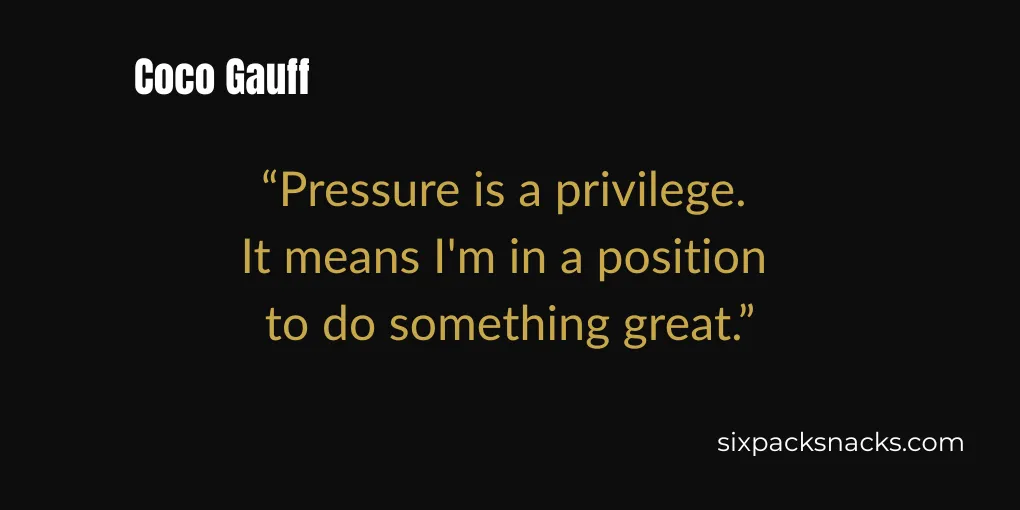
"I remind myself that pressure is a privilege. It means I'm in a position to do something great."
— Coco Gauff
That mindset shift is one of the biggest lessons from Gauff's career. Pressure is not proof that something is wrong. Pressure is evidence that you are doing something meaningful.
The other turning point came when she stopped measuring herself entirely through external expectations:
"I realized I needed to start playing for myself and not other people."
— Coco Gauff
That sentence explains how an athlete can experience a panic attack on one of the biggest stages in tennis and still find her way back into the match. Gauff isn't trying to become someone who never feels pressure. She's learning how to perform while feeling it.
Gauff's journaling habit started long before the trophies, sponsorships, and global attention.
When she was around 9 or 10 years old, her mother gave her a journal and encouraged her to create a private space where she could write down her thoughts and feelings. What began as a childhood habit became something she carried into professional tennis.
Years later, while traveling the world as a teenage athlete, that journal became a constant. Gauff has described bringing her current journal with her to tournaments and using writing as a way to process the emotional weight of competition, loneliness, expectations, and everything that comes with being a young athlete in the spotlight.
The important part is not simply that she writes. It's why she writes.
Athletes spend thousands of hours analyzing their technique, fitness, and nutrition. Journaling gives them the same opportunity to analyze their internal world. What am I feeling? Why did this moment affect me? What can I control? What do I want to carry forward?
Gauff explained that writing helps her understand what she is actually experiencing: once she can identify the problem, she can begin to address it.
That is a skill elite performers share. The goal is not to eliminate negative thoughts. The goal is to create enough awareness that emotions stop controlling your decisions.
Research on expressive writing has found that putting thoughts into words can help people organize stressful experiences, process emotions, and gain psychological clarity. For an athlete dealing with constant evaluation, travel, pressure, and uncertainty, that ability to step back and reflect can become a competitive advantage.
A guided athlete mindfulness journal makes the process easier by providing structure: pre-match intentions, post-performance reflections, gratitude prompts, and goal tracking. A guided athlete minfulness journal removes the friction of staring at a blank page by providing prompts for reflection, gratitude, performance review, and goal setting.
But, the value is not the notebook itself. The value is creating a repeatable system for understanding yourself.
The same habit appears across elite sport. Leon Marchand, the four-time Olympic gold medalist and one of the greatest swimmers of his generation, and Eileen Gu, the Olympic champion freestyle skier and X Games gold medalist who has also benefited from her detailed journaling practice, have both spoken about using reflection and mental routines to process pressure, improve focus, and stay grounded while competing at the highest level.
For athletes, the ability to calm the nervous system under pressure is a skill just like strength, speed, or endurance.
The goal is not to eliminate nerves. The goal is learning how to return to a calm, focused state when the moment demands it.
One tool designed around this concept is Sensate.
Sensate's innovative technology combines low-frequency vibrations with guided soundscapes to create a relaxation routine designed to support the body's parasympathetic response, the system responsible for helping you shift out of a high-stress state and into recovery mode.
The science behind this approach comes from growing research into vagus nerve stimulation and nervous system regulation. Studies on non-invasive vagus nerve stimulation suggest it may influence stress responses and perceived stress. A Sensate device is an excellent complement to core wellness habits like sleep, exercise, breathing practices, and mindfulness.
Most people are not competing in front of millions, but almost everyone knows what it feels like to be stuck in a high-stress state. Long workdays, constant notifications, demanding workouts, and busy schedules can leave your body feeling like it never gets a chance to switch off.
Building a simple 10-minute reset routine can help create that transition.
Sensate is designed around exactly that idea: creating a consistent moment to slow down, breathe, and signal to your body that it is time to relax and recover. Like meditation or journaling, the biggest benefit comes from making it a habit.
The lesson from Gauff is simple: mental health is not something athletes address after performance. It is part of performance itself.
Secret 3: Cross-training — beach volleyball, 400m sprints, and the strength work nobody sees
Gauff's preseason training is not what you'd expect from a tennis player.
She and her strength and conditioning coach Stephane Dal Soglio posted a preseason training clip on Instagram: bench presses, reverse crunches, and sprinting. She also tried beach volleyball, which she described as a joyful addition to her routine.She ran 400m sprints in that same period. Her caption on finishing:
"Me finishing my last 400m 😭 your girl was tired. Been doubling up fitness sessions almost all week plus tennis practice."
— Coco Gauff (Instagram)
And from that same period:
"Smiling but dying inside. Last workout of the week 🙏🏼😭"
— Coco Gauff (Instagram)
The specifics of her gym work are functional rather than aesthetic, and clearly she always aims to enjoy yourself when she's putting in the work.
Gauff's training emphasizes bodyweight exercises. Such as planks, pull-ups, and resistance bands, over heavy gym workouts. There is a dedicated focus on agility and court-specific endurance.Resistance loop bands are the specific type of bands Gauff uses for the bodyweight work she describes. They are perfect for pull-up assistance, lateral band walks, glute activation, and shoulder prehab.
These resistance lopp bands are different from the heavy pull resistance bands used in throwing or HYROX training. They are lighter, targeted, and excellent for the kind of functional movement prep that protects joints in repetitive sports.
As for Gauff's beach volleyball sessions, they serve a special purpose beyond variety. They build lateral movement, explosive jumping, and hand-eye coordination that directly transfer to tennis, all while reducing the repetitive stress of pure court work.
During the off-season, she focuses on building strength and endurance with a training routine that remains intense but strategic. "I stick to a strong training and recovery regimen, making sure I get enough rest and don't overtrain," she explains.The cross-training philosophy is one that Olympic Champion Eileen Gu and HYROX World Champion Alexander Rončević both apply.
A multi-disciplinary approach can help build physical capability outside your primary sport so your body becomes more resilient, adaptable, and better prepared when you return to competition.
Secret 4: The one-word answer that keeps training enjoyable: music
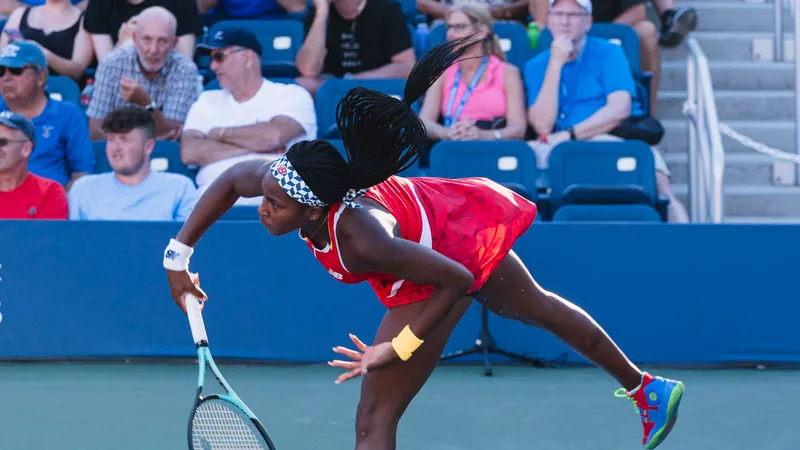
During the 2024 French Open, several US players were asked about their fitness routines. Coco Gauff's answer was surprisingly simple:
Music.
"Not necessarily an exercise. I just like to listen to music while doing whatever I'm doing. Yeah, I mean, the bike is calming."
— Coco Gauff (USTA video)
She wasn't describing a specific workout. She was describing the environment she creates around training.
The bike itself isn't what makes the session enjoyable. It is the music, the rhythm, and the mental state that comes with it.
By pairing difficult work with something she genuinely enjoys, Gauff turns training into something she looks forward to rather than something she has to endure.
That idea is more important than it sounds. Consistency is one of the biggest separators in elite sport. The best training program in the world means nothing if an athlete cannot stick with it for months and years.
Music can act as a simple psychological tool that helps reduce the perception of effort, improve mood, and make repetitive conditioning sessions feel more rewarding.
Gauff has even credited music as being more important to her fitness routine than any single exercise, a statement that makes more sense when you understand that enjoyment drives consistency.Gauff is not alone in using music as part of her performance routine. Kylian Mbappé, one of football's fastest and most explosive players, has also spoken about the role music plays in his preparation and daily routine. Many athletes prioritize creating the right mental environment before demanding physical work.
For the type of training environment Gauff describes, Sony WH-1000XM5 headphones are one of the best options for athletes who want high-quality sound and strong noise cancellation during gym sessions, indoor cycling, commuting, or recovery work.
They're not a magic performance enhancer. They're a consistency tool. The same way Gauff uses music to make training feel more enjoyable, the right headphones can help you build an environment where showing up becomes easier.
The Takeaway
Coco Gauff won the US Open at 19. She defeated Venus Williams at 15. She experienced a panic attack on one of tennis' biggest stages, named it honestly, reset, and kept competing.
None of that came from a magic diet, a secret workout, or a perfect routine.
It came from thousands of small decisions repeated over years: eating foods that fuel her body, building transferable skills outside of her sport, training her mind as deliberately as she trains her forehand, and creating an environment where hard work still feels enjoyable.
"It's important for us to know that our worth isn't defined by how well we do in our sport."
— Coco Gauff
The goal is not to become Coco Gauff. The goal is to understand the principles behind what makes her great: take care of your body, train your mind, enjoy the process, and show up every day.
As we always say at Sixpack Snacks: if you want to be the best, practice the habits of the best.
Coco Gauff's Essentials:
-
Naked Protein Pineapple Orange Smoothie (Gauff's signature smoothie: 20g of plant-based protein, pineapple, orange juice, electrolytes, and a convenient way to fuel busy training days)
-
Vitamix Blender (a premium, high-powered blender for turning protein powders, fruits, greens, and whole-food ingredients into smooth, performance-focused smoothies in seconds)
-
Sensate (a 10-minute daily reset tool to help transition from stress mode into recovery mode, supporting the breathing, mindfulness, and mental resilience practices Gauff relies on)
-
Five Minute Journal (a practical way to build the reflection habit Gauff has used throughout her career)
-
Sony WH-1000XM5 Headphones (the equipment behind Gauff's simplest training secret: music)
-
Resistance Loop Bands (a simple but powerful tool for warm-ups, glute activation, injury prevention, and building athletic strength anywhere)
Coco Gauff's story is ultimately not just about tennis. It is about building a body and mind capable of handling pressure, adapting to challenges, and showing up consistently. Those lessons extend far beyond the court. Halle Berry has followed a similar philosophy for decades, using training, recovery, and discipline as tools for staying strong and healthy well into her fifties.
Mental resilience is a thread that runs through many great athletes' stories. Read our in-depth post about Carlos Yulo, the Olympic champion gymnast, to learn how he overcame personal struggles, low self-confidence, and difficult moments on his journey to becoming one of the world's best.
Sources
- Men's Fitness — Coco Gauff's Non-Restrictive Approach to Nutrition
- CelebWell — Coco Gauff's Diet for Peak US Open Performance
- Mashed — What Coco Gauff Eats in a Day
- Sports Illustrated — Coco Gauff Serves Signature Naked Smoothie at 2025 US Open
- Parade — Tennis Star Coco Gauff Reveals Her Cheat Day Meal
- True Star — When Anxiety Strikes: Coco Gauff's Courage on the US Open Court
- Morning Honey — Coco Gauff Reveals How She Takes Care of Her Mental Health Ahead of 2024 Olympics
- Black Girls Bond — Coco Gauff Shares Her Powerful Holiday Recovery Routine
- Sportskeeda — Coco Gauff Switches From Tennis to Beach Volleyball in Preseason Training
- The Sports Rush — Coco Gauff Names the One Word That Defines Her Fitness Routine
- BrainyQuote — Coco Gauff Quotes
- Sportskeeda — Coco Gauff Training Update: Smiling but Dying Inside
- Sportskeeda — Coco Gauff Shares Glimpses of Fun Day Delighting in Scrumptious Meals Ahead of Wimbledon
- PubMed — Bromelain: Biochemistry, Pharmacology and Medical Use
- NIH Office of Dietary Supplements — Vitamin C Fact Sheet for Health Professionals
- PubMed — Effects of Music in Exercise and Sport: A Meta-Analytic Review
- Sensate — Research and Technology Overview
- ClinicalTrials.gov — Sensate II Utilization and Perceived Stress in Adults
- Biological Psychology — Effects of Transcutaneous Vagus Nerve Stimulation on Perceived Stress
- The Washington Post — Coco Gauff’s Tennis Success Has Given Her a Platform. She Wants to Use It.
- PubMed — Expressive Writing and the Role of Self-Disclosure in Psychological Health
- PubMed — Health Effects of Expressive Writing on Stressful or Traumatic Experiences: A Meta-Analysis
- PubMed — Randomized Controlled Trial of Expressive Writing for Psychological and Physical Health
This article is for informational purposes. Always consult a qualified coach, nutritionist, or medical professional before starting a new training or nutrition program.