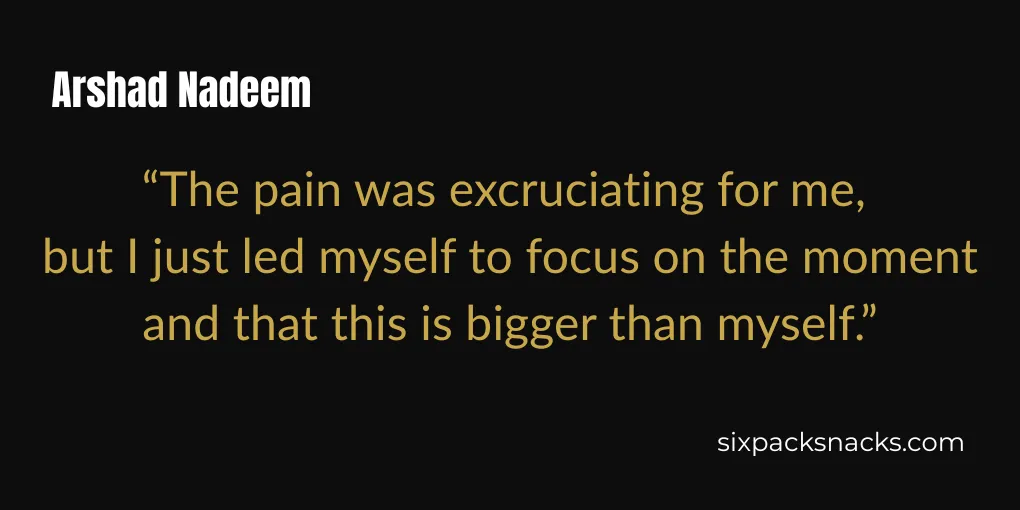
Arshad Nadeem's Training Secrets: 4 Habits Behind Pakistan's Olympic Record
The 4 Habits Behind the Man Who Threw 92.97 Metres With a Damaged Javelin and Broke the Olympic Record
What does Arshad Nadeem's training routine look like?
How does a kid from a small village in rural Pakistan become the Olympic javelin champion with a throw that shattered the Olympic record?
A Sneak Peek into Arshad's 4 Training Secrets:
- A training foundation built on eucalyptus branches and oil canisters
- Six hours a day in 45°C heat, split to survive the conditions
- Competing through multiple surgeries — the injury philosophy that refuses to quit
- Capitalizing on the healthy and macro-nurtient dense components of a traditional Pakistani diet
Keep Reading to Learn More …
On August 8, 2024, at the Paris Summer Olympics, Pakistan's Arshad Nadeem's second throw of the final travelled 92.97 metres.
His rival and close friend, Neeraj Chopra of India, the defending Olympic champion at the time, finished more than three metres behind him.
And with that powerful throw, Nadeem didn't just break the Olympic record in the men's javelin. He brought home Pakistan's first individual Olympic gold medal in athletics and the country's first individual Olympic gold in 40 years.
Four habits helped lead him to that spectacular moment. None of them came easily.
Secret 1: Built From Nothing — Homemade Equipment and an Unbreakable Foundation
Perhaps, one of the most outstanding features of Nadeem's glorious feat at the 2024 Olympics was that he was using a damaged, seven-years old javelin that day.
It was the only one he had. Pakistan had not provided him with a better one.
Yet, despite the odds, he had the best performance that day.
Ironically, Nadeem's early training tools were always improvised from whatever was available. And, whatever was avaiable for Nadeem growing up was far worse than an old and broken Olympic javelin.Long before he ever held a professional javelin, Nadeem trained with whatever he could find.
He carved homemade javelins from eucalyptus branches, weighting the tips with iron, and built homemade weights from oil canisters filled with concrete.
The man who broke the Olympic record in the javelin learned to throw with a sharpened eucalyptus branch.
That was the javelin available for a poor teen growing up in Mian Channu, a small village in rural Punjab, Pakistan. So that was what Arshad Nadeem used to train as he grew up.
Nadeem’s father, Muhammad Ashraf, was a construction worker. In a family of eight children, every dollar was assigned to survival before it was even earned. But, when Ashraf saw his son's natural throwing ability, first in cricket, then the shot put, and finally the javelin, he refused to let poverty decide his future.
When there was no money for proper shoes, diet, or travel to regional meets, his father sacrificed his own meager meals and worked longer hours.
There were times when even that wasn't enough. When travel costs became too much, the people of Mian Channu passed the hat, collecting whatever rupees they could so Arshad could make it to his next competition.
Nadeem's physical gifts were visible early, and his devoted father did his best to nurture it.
By the age of 14, Nadeem already stood nearly six feet tall. His older brother credited their father, who is also over six feet, for the family's height.That combination of size, natural power, and relentless work quickly caught the attention of local coach Rasheed Ahmed Saqi.
In 2011, a local coach and hotelier named Rasheed Ahmed Saqi saw the lanky teenager compete at a local event and was impressed enough to track the family down.
Two weeks later, Nadeem's father Muhammad Ashraf brought his son to Saqi's office. What happened next shaped everything.
"Arshad is your son and your responsibility from today."
— Muhammad Ashraf, Arshad's father, to coach Rasheed Saqi
Saqi took him in. A few years later, Nadeem secured a retainer agreement with WAPDA, Pakistan's Water and Power Development Authority, which sponsors Pakistani athletes. It was the first structured support he had received.
The homemade equipment years aren't just a backstory. They built something that purpose-built training facilities often don't: a clear understanding that the tool is secondary to the work.
Those years with homemade equipment weren't just part of the story. They shaped the way Nadeem approached the sport.
He learned early that progress comes from the work, not the equipment.
For years he threw homemade javelins because that's all he had. Ironically, when the biggest competition of his life arrived, he found himself relying on another imperfect tool: a battered seven-year-old javelin.
Different stage. Same mindset.
At every stage of his career, Nadeem focused on getting the absolute most out of whatever was in front of him.
His story is also a reminder that great athletes are rarely built alone.
It took a father willing to sacrifice, a coach willing to invest his time, and an entire community willing to help a young athlete chase a dream that seemed impossible.
Talent opened the door. Family, coaches, and relentless work built the foundation for good things to come and help carry him through until they actually transpired.
Before reaching the pinnacle of international athletics, Arshad Nadeem trained extensively with Nemeth javelins, one of the most respected manufacturers in the sport. He reportedly switched to Nemeth just a few years before the Paris Olympics after relying on locally made javelins that placed greater strain on his shoulder and elbow. Upgrading to a professional-grade javelin provided more consistent flight characteristics, improved balance, and greater durability during high-volume training. Those improvements allowed him to train with equipment that met international standards while reducing the limitations of lower-quality implements.
Today, Nemeth remains one of the world's most trusted javelin brands, widely used by competitive athletes, coaches, and national training programs for its precision engineering, reliability, and elite-level performance.
If you're a competitive javelin thrower, or aspiring to compete at a high level, the NEMETH Competition Javelin – Standard – 600 GM – 70 M is an excellent choice. It's a World Athletics-certified competition model built for advanced athletes who demand professional-level balance, consistency, and performance.
For most athletes, however, developing explosive strength, rotational power, and throwing mechanics will have a much bigger impact than upgrading to an elite competition javelin. A Heavy Medicine Ball is one of the best training tools you can own. The same rotational power developed through medicine ball exercises transfers directly to the javelin throw, while also benefiting tennis serves, baseball pitching, golf swings, cricket bowling, and countless other explosive athletic movements.
A simple, cost-efficient set of Heavy Resistance Bands is another humble tool that punches well above its weight. You can use them literally anywhere. They're perfect for building shoulder stability, hip strength, and rotational power without needing a fully equipped gym.
Resourcefulness became one of Nadeem's greatest competitive advantages. He never waited for perfect equipment or conditions. He trained with whatever he could afford and get his hands on, with the profound understanding that hardwork pays off.
Secret 2: Timing Everything — Why Nadeem Trains With the Clock, Not Against It
Arshad Nadeem's training is split into two three-hour sessions each day, one in the morning and one in the evening, specifically to avoid the most punishing heat of the Pakistani summer.That's six hours of training.
But the secret isn't the number of hours. It's when those hours happen.
Elite athletes don't just train hard. They organize their lives around performing well during training. Nadeem understands that quality matters more than simply grinding through fatigue. Strength work, technical throwing, recovery, meals, and rest all happen at deliberate times so each session gets his best effort.
Even then, there are days when the weather can't be avoided. In May 2024, Nadeem shared video of himself throwing in temperatures reaching 45°C."I'm used to the conditions."
— Arshad Nadeem
Training in extreme heat became part of his advantage. Learning to perform through it strengthened both his conditioning and his mental toughness. If he could throw with precision in those conditions, competition day felt that much easier.
His coach, Salman Butt, has repeatedly emphasized proper hydration and pacing during outdoor sessions rather than simply pushing harder.
Butt noted that Nadeem avoids overexerting himself during training and makes hydration a priority throughout every session. Keeping cold water close by makes it easier to drink consistently throughout long sessions.
Sweat doesn't just cost you water. It also drains sodium, potassium, and other electrolytes that are essential for muscle function, coordination, and power output. Replacing those minerals consistently helps you maintain performance through long sessions instead of fading as fatigue sets in.
If you're regularly training outdoors, playing sports in the summer, or spending hours in the gym, keeping a box of LMNT electrolyte packets on hand is one of the simplest habits you can build. Just mix one into your water before or during longer sessions. Sometimes staying at your best isn't about pushing harder. It's about replacing what your body loses so you can keep performing at a high level.
The same mindset of pacing and deliberate alterations of intensity Nadeem possesses extends beyond a single workout.
"After winning gold in 2024, my aim is to secure even more titles in 2025. I've already resumed training following a four-month break, focusing on fitness to ensure I'm prepared for the challenges ahead."
— Arshad Nadeem
Notice what he didn't do after becoming Olympic champion.
He didn't immediately chase personal bests.
He spent months rebuilding his fitness before returning to full throwing sessions. That's how elite athletes think.
Every season has a purpose. There are periods for building strength, periods for refining technique, periods for competing, and periods for recovering. Trying to do everything at once usually means doing nothing exceptionally well.
It's a lesson anyone can apply.
Instead of asking, "How can I fit training into my day?" ask, "What time of day gives me the best chance to train well?" Protect that window. Treat it like an important meeting you can't miss.
One tool that reflects Nadeem's approach is The Time-Block Planner by Cal Newport. Its entire philosophy is simple: schedule your most important work first, then build everything else around it.
That's exactly how elite athletes operate.
Training isn't something they squeeze in whenever they have time or when they "feel like it". It's protected on the calendar like any other non-negotiable commitment.
If you struggle with consistency, learning to time-block your workouts may do more for your progress than changing your program ever will.
Consistency is often less about motivation than it is about scheduling.
The athletes who improve year after year usually aren't the ones with the perfect program. They're the ones who show up at the same time, week after week, and let the work compound.
Secret 3: The never-stop philosophy — winning through surgery
The details of Arshad Nadeem's injury history are uncomfortable to read.
He nursed an elbow injury from the Tokyo Olympics through his return to competition at the 2022 World Athletics Championships, where he finished fifth with an 86.16m throw. He then won Commonwealth Games gold in Birmingham with a strapped elbow, throwing 90.18m, the first South Asian to breach 90 metres, before undergoing elbow surgery in London in December 2022. A knee injury followed in 2023. He had another knee surgery in February 2024, then went to Paris five months later and broke the Olympic record.Multiple surgeries. Multiple comeback cycles. Yet, his relentless earned him gold medals at each stage.
His own description of managing all this is remarkably steady for someone competing through this level of physical compromise:
"I wasn't worried. I really have not panicked at all during this time because I have it in me to do my best. I have been competing with injured knees and elbow before. Like that right knee was troubling me before the World Championships, but I was careful and managed the training accordingly. I performed accordingly, I got the medal at the World Championships with the injury, before that my left knee was injured too. So I am not worried how I would play. I have always been hopeful, and Allah has helped me."
— Arshad Nadeem
The quote that captures his whole relationship with physical adversity:
"I will give my all for Pakistan, till my legs are working, I'll keep fighting."
— Arshad Nadeem
He describes himself as an introvert and a devout Muslim. His faith and his sense of duty to Pakistan are the two things his quotes return to consistently. Neither yields to injury.
Nadeem endured rigorous rehabilitation and multiple surgeries not just out of a love for the javelin, but because he was determined to bring international recognition to Pakistan and make his family proud. Having specific, tangible goals helped him maintain his discipline through physical setbacks and difficult recoveries.
The athletes who stay consistent for years usually aren't the ones with the most talent. They're the ones who always remember why they started.
For Nadeem, that "why" was never difficult to find. Every time he stepped onto the runway, he wasn't just throwing for himself. He was throwing for his family, his faith, and an entire nation that believed in him.
Throwing at maximum velocity generates extreme shear force that breaks down cartilage and connective tissue fast. Muscles recover in 48 hours. Tendons don't, not without the raw materials to rebuild. If your knees or shoulders ache after a heavy session, the structural tissue is failing to keep up with the load you're putting through it.
Analysis from Examine.com confirms that hydrolyzed collagen peptides address this deficit directly. In a 24-week trial tracking active adults with chronic joint pain, 72% of the collagen group reported sustained pain relief, compared to 18% on placebo. The researchers also recorded measurable gains in explosive lower-body power, because collagen increases tendon stiffness and elasticity alongside reducing pain.
Standard whey protein handles muscle repair well. It doesn't carry the specific amino acid profile that joint tissue needs to rebuild. Ten grams of collagen daily, paired with Vitamin C to support tissue synthesis, is a well-documented addition to any serious training routine.
Not a cure, not a shortcut. Just structural support that most athletes should be taking and aren't.
A high-quality collagen supplement that already includes vitamin C, like Sports Research Collagen Peptides with Vitamin C, makes it easy to support both collagen production and connective tissue repair in one serving. It's not a miracle cure or a substitute for smart training, but for athletes putting heavy stress on their joints, it provides the building blocks your body needs to recover and stay durable over the long haul like Nadeem.
Secret 4: The nutrient-dense desi diet — milk, ghee, and the food that built an Olympic record
Ask Arshad Nadeem about his diet and the answer has nothing to do with macros or periodization.
Despite his father's small daily income of Rs 400 to 500 a day (significantly below the legally mandated minimum pay scale in Pakistan), he made sure Arshad never missed out on his power-packed essentials: milk and ghee. These traditional staples were as integral to Nadeem's diet as his training sessions."I totally have a desi diet. Desi Murgi (chicken), Desi Anda (egg), Desi Ghee. Agar uske saath lassi hoo jaae to best hai." (Translation: If I had Lassi along with it, then it's the best.)
— Arshad Nadeem
The nutritional case for a traditional Pakistani diet is stronger than modern sports commentary gives it credit for. Free-range chicken and eggs supply complete protein and quality fat. Desi ghee (clarified butter from grass-fed animals) is rich in fat-soluble vitamins A, D, E, and K2, conjugated linoleic acid, and medium-chain triglycerides, all of which support hormonal function under high training loads. Lassi is fermented dairy: protein, probiotics, and calcium for bone health.
These foods gave a developing strength athlete exactly what he needed. High-quality protein for muscle growth, quality fat for hormonal health, calcium for the bone density that absorbs the impact of throwing mechanics.
Even when the family had limited resources, Nadeem's diet was built around these whole-food staples.High-output training demands massive caloric intake, but relying on highly processed seed oils for cooking can sabotage your recovery before it even starts. When you heat standard cooking oils, they rapidly oxidize and flood your system with free radicals, triggering the exact kind of systemic inflammation athletes need to avoid.
Swapping those industrial fats for grass-fed ghee completely changes the metabolic math. The clarification process strips away the milk solids, specifically lactose and casein, leaving behind a pure, highly stable lipid profile with a massive 485°F smoke point. You can subject it to intense heat without degrading its molecular structure. Therefore, making it an excellent option for cooking.
A quality option like 4th & Heart Grass-Fed Ghee also removes the milk solids, leaving it naturally free of lactose and casein while retaining beneficial fats and fat-soluble vitamins. Grass-fed ghee contains naturally occurring butyric acid and Conjugated Linoleic Acid (CLA), nutrients that have been studied for their roles in gut health and overall wellness. It's a simple upgrade that turns an everyday cooking ingredient into one that better supports a high-performance diet.
The fat-soluble vitamin content and clean fat profile make it a functional food, not just a flavour choice.
Grass-fed ghee deserves far more attention than it gets. While everyone chases the latest supplement, upgrading the foods you cook with every single day may have a bigger impact over the long run.
The best athletes know performance is built meal by meal, not scoop by scoop.
The Takeaway
Arshad Nadeem threw a seven-year-old damaged javelin 92.97 metres and broke the Olympic record. He did it five months after knee surgery. He did it for a country that gave him inconsistent support, sometimes appalling accommodation, and no new javelin before the biggest competition of his life.
He did it anyway.
"I compete against myself."
— Arshad Nadeem
When the external circumstances aren't ideal, and for Nadeem they rarely have been, the only standard that remains is the one you set for yourself. That's what carried him farther than anyone had ever thrown at an Olympic Games.
As we always say at Sixpack Snacks: if you want to be the best, practice the habits of the best.
Train Like Arshad Nadeem:
- NEMETH Competition Javelin – Standard – 600 GM – 70 M (the same professional-grade brand Arshad Nadeem trained with before reaching the Olympic stage, built for advanced and competitive javelin throwers)
- Heavy Medicine Ball (build explosive rotational power for throwing, tennis, baseball, and other rotational sports)
- Heavy Resistance Bands (develop shoulder stability, hip strength, and rotational power anywhere)
- LMNT Electrolyte Packets (replace the sodium and electrolytes lost through sweat)
- Time-Block Planner (schedule training like elite athletes who protect their practice time)
- Sports Research Collagen Peptides + Vitamin C (support connective tissue, tendons, joint health, and recovery from intense training)
- 4th & Heart Grass-Fed Ghee (upgrade everyday cooking with a high-heat, athlete-friendly fat source)
For more on athletes who came back from adversity to reach the top, read our breakdown of Carlos Yulo's training secrets — the Filipino gymnast who crashed at Tokyo and came back to win double gold in Paris.
Sources
- Al Jazeera — 'I Compete Against Myself': Meet Pakistan's Olympic Javelin Thrower
- Grokipedia — Arshad Nadeem: Career, Training, and Olympic Record
- Britannica — Arshad Nadeem Biography
- Express Tribune — Arshad Back at Training After Knee Surgery
- Olympics.com — Pakistan Javelin Ace Arshad Nadeem Undergoes Elbow Surgery
- The News International — Arshad Nadeem Resumes Training With Ambitious Plans
- myKhel — Neeraj Chopra vs Arshad Nadeem: How Do Both Olympic Stars Eat?
- Wikipedia — Arshad Nadeem
- Examine.com — Type-II Collagen Database
- Current Medical Research and Opinion — 24-Week study on the use of collagen hydrolysate as a dietary supplement in athletes with activity-related joint pain
- The American Journal of Clinical Nutrition — Vitamin C–enriched gelatin supplementation before intermittent activity augments collagen synthesis
- WebMD — Ghee: Health Benefits, Nutrition, and High-Heat Oxidative Stability
- Cleveland Clinic — What Is Butyrate? Gut Health Benefits and Anti-Inflammatory Effects
- Frontiers in Physiology — Milk From Cow Fed With High Forage Diet: Beneficial Effects on Inflammatory State and Lipid Metabolism
- Examine.com — Conjugated Linoleic Acid (CLA) Supplement Database and Research Breakdown
- A Comparative Analysis of Butter, Ghee, and Margarine and Its Implications for Healthier Fat and Oil Group Choices
- Gut Microbial Metabolite Butyrate and Its Therapeutic Role in Inflammatory Bowel Disease: A Literature Review
- The “Grass-Fed” Milk Story: Understanding the Impact of Pasture Feeding on the Composition and Quality of Bovine Milk
This article is for informational purposes. Always consult a qualified coach, nutritionist, or medical professional before starting a new training or nutrition program.