Alex Honnold's Health and Training Secrets: What the World's Greatest Free Solo Climber Can Teach You
The 4 Habits Behind the Man Who Climbed a 1,667-Foot Skyscraper With No Rope
What does Alex Honnold's training routine look like?
How does someone prepare to climb a 3,000-foot rock wall, or a 101-story skyscraper, without a safety net of any kind?
A Sneak Peek into Alex's 4 Training Secrets:
- A finger strength obsession that started at age 5
- A visualization system so detailed it includes dying
- A performance journal he's kept since 2005
- A plant-based diet fueling feats most meat-eaters couldn't dream of
On January 25, 2026, Alex Honnold, 40, climbed Taipei 101, a 1,667-foot skyscraper in Taiwan, without a rope. No harness. No safety gear. Just him, his hands, and a sheer drop onto the streets below.
Millions watched the climb unfold live on Netflix.
Every move had already been rehearsed hundreds of times in his mind before he ever left the ground.
His first words at the top: "Sick."
Then, he took a selfie.
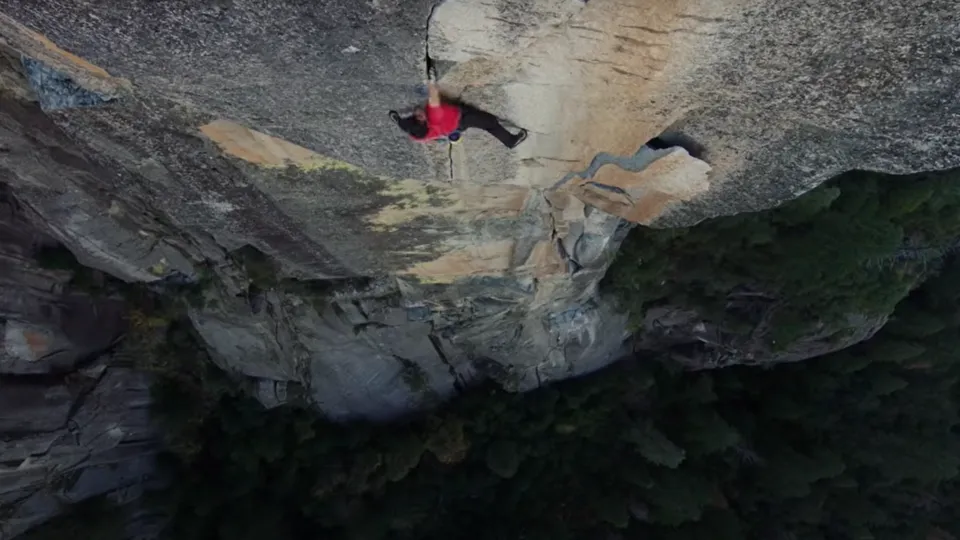
If you already know Honnold, none of this surprises you. In 2017, he became the first and still only person to free solo El Capitan, a 3,000-foot granite wall in Yosemite. A feat so unlikely that the climbing community had debated for years whether it was even survivable.
The Academy Award-winning documentary Free Solo captured the preparation, the relationships, and the climb itself. It remains one of the most extraordinary athletic films ever made.
But here's what most people get wrong about Alex Honnold: they think he's fearless. He isn't.
He's arguably one of the most meticulously prepared athletes in the world.. And the difference between fearlessness and preparation is where everything interesting lives.
Secret 1: Finger Strength — The Unglamorous Foundation
Start with the basics. That's what Honnold does.
Honnold has said openly that finger strength has "always been my weakness," which is a remarkable admission from a man who has just climbed a skyscraper with his bare hands.
That mindset runs through everything Honnold does: he goes after his weaknesses instead of polishing his strengths.
The tool he uses to build finger strength is a hangboard. A hangboard is a small wooden or plastic board mounted to a wall with various grip positions cut into it.
You hang from it. That's basically the whole exercise.
You can vary your grip type, your hang duration, and sometimes add weight. It sounds deceptively simple.
In practice, it's brutal. And, extremely effective.
"There's different strategies for different things — hanging, varying grips, adding weight. If I do a hard finger workout, I'm definitely sore," Honnold has said.Beyond the hangboard, his training for specific climbs goes to extremes most gym-goers would find hard to believe. Preparing for Taipei 101, he was spotted at the gym doing pull-ups using just his fingertips gripped against the side of a squat rack.
What makes Alex Honnold's fingers capable of feats that seem impossible? The answer is the same thing behind Alex Honnold's grip strength: thousands of hours of progressive training that allowed his fingers, tendons, and forearms to adapt safely over time.
When he was preparing to climb El Capitan in Yosemite, Honnold was training 40 or more hours a week. Training 40 hours a week isn't just about getting stronger. It's about repeating movements until they become second nature.
Now, you probably don't have 40 hours a week to dedicate to climbing. That's okay. The good news is you don't need to.
The same training principles can be applied at home with the right equipment, starting with the tool Honnold himself relies on.
A hangboard is one of the most effective tools for developing the finger strength and grip endurance that separate good climbers from elite ones. Unlike traditional strength training, hangboard work targets the exact qualities climbing demands: the ability to generate force through the fingers, hold small edges, and resist fatigue on the wall.
The evidence backs it up. In a 10-week study of 35 intermediate and advanced climbers, researchers used the Beastmaker 1000 hangboard twice per week alongside normal climbing sessions. The hangboard group improved peak finger force by 17%, average force by 18%, and finger endurance by 12%, while the control group saw no comparable improvements.
The two names you'll see most often among serious climbers are Metolius and Beastmaker.
Metolius hangboards are known for their versatility, with a range of hold sizes that make them ideal for beginners and intermediate climbers building a foundation while learning proper loading technique. They are forgiving enough to train consistently without constantly pushing into injury territory.
Beastmaker hangboards are designed for climbers who already have a strength base and want a more advanced challenge. Their smaller edges and deeper pockets allow experienced climbers to specifically target maximum finger strength, the same quality Honnold has spent decades developing. The Beastmaker 1000 was the exact board used in the study referenced above, making it one of the rare climbing tools with research directly examining its use in a structured training program.
When choosing which is the best hangboard to buy, think of it this way: Metolius is the better choice for most climbers. Its wider range of holds makes it ideal for beginners and intermediate climbers who want to build finger strength safely and consistently.
Whereas, Beastmaker is the upgrade for experienced climbers who already have years of training behind them and want to push their maximum strength further.
For climbers chasing the level of finger strength that defines athletes like Alex Honnold, a Beastmaker is closer to the type of specialized training tool used by elite climbers. Honnold himself has trained extensively with hangboards throughout his career, using progressive finger training to build the strength required for some of the hardest climbs on Earth.
Pair it with high-quality climbing chalk. It might seem like a small detail, but when you're relying on fingertips to support your entire body weight, friction matters. Dry hands reduce slipping, help you conserve grip strength, and give you more confidence when committing to difficult moves.
Friction Labs has become one of the most trusted chalk brands among professional climbers, including Honnold, thanks to its high-purity magnesium carbonate formula designed to perform consistently indoors and outdoors. It's one of those simple upgrades that makes every session feel more controlled.
The equipment matters, but the years of patient progression matter more. The results comes from showing up consistently, training progressively, and allowing your body time to adjust as you train on the hangboard.
Secret 2: Visualization — The Mental System That Stands Between Him and Death
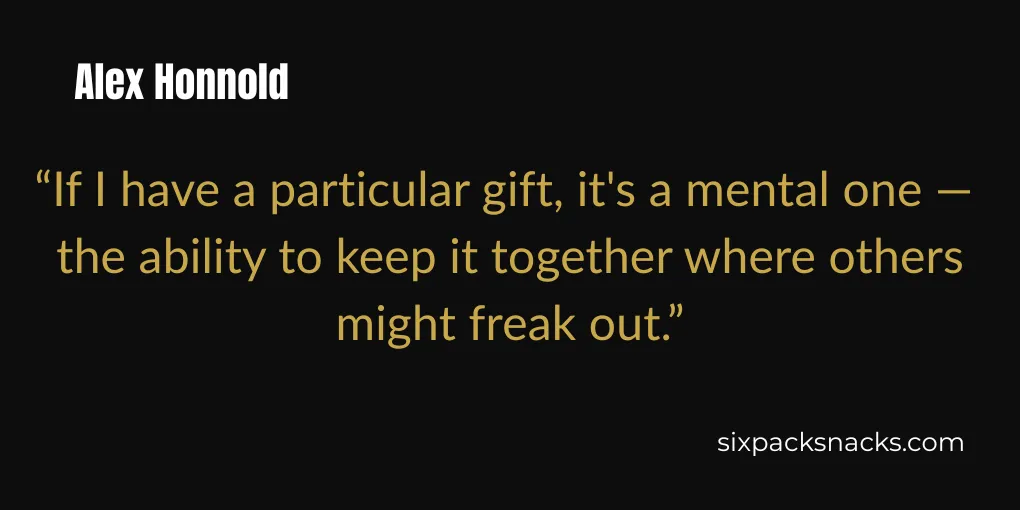
"I totally get nervous before big climbs. Nervousness isn't fear. It's a sign that I'm about to do something that matters."
— Alex Honnold
If you've ever felt nervous before a race, presentation, or a difficult conversation, you're in good company. Turns out even the guy who climbs 1,600-foot skyscrapers without a rope still gets butterflies.
Where Honnold differs from most of us is that he doesn't confuse nervousness with fear.
Fear, to him, is a signal that preparation is incomplete. Nervousness is proof that what you're about to do is real.
For Honnold, nervousness isn't something to eliminate. He understands that nervousness often shows up naturally when you're about to do something meaningful.
On the Tim Ferriss Show, Honnold described his visualization practice in detail: "I'll think through the sequences and make sure that I remember which foot to move in which order and like how to do everything. And then if I'm climbing ropeless, then I'll think through what it'll feel like to be in certain positions. Because some kinds of movements are just scarier. It's important to think through how that will all feel when I'm up there, so that when I'm doing it, I won't suddenly be like, Oh my God, this is really scary. I know that it's supposed to be scary, I know what it's going to feel like, and I just do it."He doesn't visualize success; he visualizes the experience. Including the frightening parts so that nothing on the wall catches him off guard.
His preparation for El Capitan literally included visualizing falling and even dying. Not to dwell on it, but to remove its power over him by the time he was actually on the rock.
He climbed "in the absence of fear." But, only because fear was a signal that he was not prepared enough. When the preparation was complete, the fear left. Not because he suppressed it, but because he had genuinely eliminated the uncertainty that was feeding it.
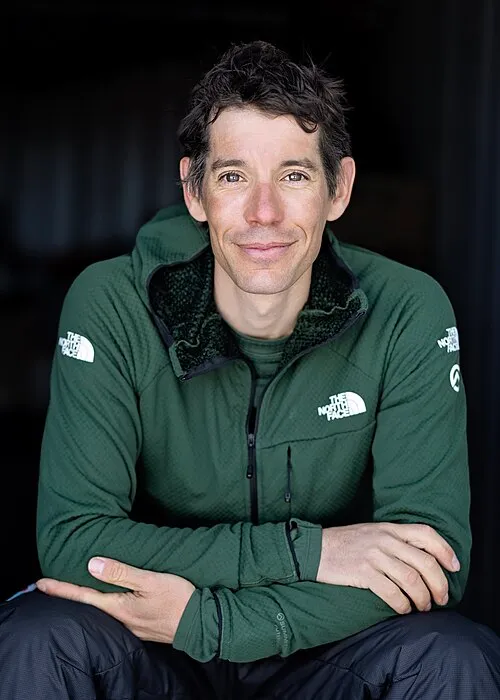
In a pre-climb interview for the Taipei 101 ascent, Honnold acknowledged that he isn't naturally the strongest athlete but that "the mental side has always come relatively easily to me, but the physical side I have to work at." His assessment of that tradeoff: "Basically, someone's always struggling with whatever it is that they lack."There is also a remarkable piece of neuroscience attached to Honnold's story. In 2016, neuroscientist Jane Joseph scanned his brain using fMRI technology designed to provoke fear and emotional arousal. His amygdala, the brain's threat-detection center, did not activate in response to fear-inducing images.
The results surprised the researchers. His brain responded very differently from most people's.
It's important to note that Honnold has repeatedly said he still experiences fear on the wall.
His secret is that he's learned to distinguish useful fear from unnecessary fear through years of preparation. Instead of trying to eliminate fear, he learned to work with the kind that actually keeps him safe.
Honnold's own take on it was more grounded: "I've always been scared climbing, but I think the more obvious thing is that when you get scared all the time for years on end, you get really good at not being too scared. It loses some of its power and you get better at differentiating which fears matter and which fears don't."
His memoir, Alone on the Wall, covers the mental framework behind his climbing in his own words. It's part adventure story, part performance psychology manual, and one of the more honest accounts of fear management written by any athlete in any sport. Worth reading regardless of whether you've ever touched a climbing wall.
Secret 3: The Performance Journal — Every Climb Since 2005
Honnold has kept a journal of everything he's ever climbed since 2005. For the entry about free soloing Half Dome, he put a frowny face and added some little notes about what he should have done better, then underlined it.Half Dome. Which he free soloed. With a frowny face and notes on what needed to improve.
That entry captures Honnold's relationship with his own performance better than any summary could. He's not interested in celebrating what went right. He's interested in understanding what needs to be better.
That's what the journal is for.
Climbs go in, observations go in, weaknesses go in. It's a decades-long conversation with himself about the craft.
He records all his climbs and notes what he needs to improve. He says climbing sometimes doesn't feel right and you need to know when to say when. He credits listening to his instincts for his incredible success in free soloing.This habit connects directly to how Honnold approaches his visualization work. Every entry feeds the next climb. The patterns he notices over years of entries inform what he focuses on in training. It's a feedback loop he's been running for over two decades.
For anyone serious about performance, an athlete-specific training journal is one of the most consistently underused tools available. You don't need Honnold's stakes to benefit from his habit. Tracking workouts, noting what felt off, identifying patterns across weeks and months. It's the kind of reflection that separates athletes who plateau from athletes who keep improving.
Honnold isn't the only elite athlete who journals. Olympic skier Eileen Gu has spoken about using journaling to reflect on training, while Olympic swimmer Leon Marchand's training credits structured mental preparation as one of his biggest competitive advantages. Different sports, same habits: taking the time to reflect and improve.
Secret 4: The Flexible Vegetarian — Fueling El Cap on Mostly Plants
Honnold describes himself as a "flexible vegetarian," consuming fish sometimes. Rather than chasing protein targets, Honnold focuses on eating simple whole foods and adjusts his diet when training demands increase.He eats what works, keeps it simple, and applies the same minimalist ethos to food that he applies to everything else in his life.
A day of eating might start with muesli and hemp milk or scrambled eggs with vegetables and a tortilla. Snacks throughout the day are whole foods: nuts, fruit, or avocados on bread. Dinner from a van cooktop might be squash, peppers, spinach, and noodles topped with cheese and pumpkin seeds.He doesn't drink or smoke. He eats red bell peppers like apples. He loves cookie dough. For years he didn't even have a refrigerator.
Food is fuel, and he's deliberate about eating what helps him perform and recover.
Alex Honnold's height and weight is roughly 5 ft 11 in (180 cm) and 160 lb (73 kg), Alex Honnold explains to GQ that climbing is a "full body" effort and that "strength-to-weight" ratio is essential. So, he deliberately maintains a stable weight.
As one can imagine, extreme rock climbing taxes the muscles and nervous system so much that Honnold frequently adds eggs to his diet to compensate for the lack of protein. His diet adapts to the demand.
At 40, Honnold is still doing things no other human has ever done, fueled largely by fruits, vegetables, and simple whole foods.
If you're an athlete following a vegetarian diet closely resembling veganism, like Honnold, it's important to remember that consuming enough B-12 can be hard to get from plant-only sources. Calcium and vitamin D are also harder to absorb from plants. Bones and joints take a particular beating for climbers.A high-quality Vitamin B12 supplement is one of the most important additions for anyone following a plant-based or vegetarian diet. Deficiency develops slowly and can affect energy, nerve function, and mood before most people notice anything is wrong. It's worth considering if you follow a mostly plant-based diet.
For the protein side, a clean plant-based protein powder covers the gap on training days when whole food intake falls short. The key word is clean. Minimal ingredients, no artificial sweeteners, nothing that works against the kind of simple-whole-food foundation Honnold's diet is primarily built on.
Conclusion
Honnold doesn't rely on courage. He relies on preparation.
Alex Honnold's approach to performance strips away everything that isn't essential. He trains his weaknesses, not his strengths. He visualizes failure so it can't surprise him. He journals obsessively so the lessons compound. He eats simply because simplicity is sustainable.
None of it is glamorous. All of it works.
As we always say at Sixpack Snacks: if you want to be the best, practice the habits of the best.
Alex Honnold's Essentials:
- Metolius Hangboard (build the finger strength everything else depends on)
- Friction Labs Climbing Chalk (grip is everything)
- Alone on the Wall by Alex Honnold (the mental framework in his own words)
- Athlete Training Journal (the feedback loop that compounds over years)
- Vitamin B12 (essential for any plant-forward athlete)
- Clean Plant-Based Protein (close the gap on hard training days)
For more on the mental side of elite performance, check out our breakdown of Leon Marchand's training secrets — the swimmer who credits 70% of his performance to mental training.
Sources
- Tatler Asia — Alex Honnold on Fear, Focus, and Performance
- Optimize Mind Performance — Alex Honnold's Mental Skills
- Steve Magness — A Look into Alex Honnold's Brain
- Yahoo Sports — Inside Alex Honnold's Brutal Workout
- Total Shape — Alex Honnold Workout Routine and Diet Plan
- Fitness Clone — Alex Honnold Workout Routine and Diet
- Alex Honnold Quotes — AllGreatQuotes
- TED — How Free Solo Climber Alex Honnold Faces Fear
- Renew Your Recipe — Fueling a 101-Story Climb on Mostly Plants
- PubMed — Hangboard Training in Advanced Climbers: A Randomized Controlled Trial
- PubMed — Effects of Different Hangboard Training Intensities on Finger Grip Strength, Stamina, and Endurance
- PMC — The Effects of 10 Weeks Hangboard Training on Climbing Specific Maximal Strength, Explosive Strength, and Finger Endurance
- Beastmaker — Official Hangboards
- Metolius — Official Climbing Equipment
This article is for informational purposes. Always consult a qualified coach, nutritionist, or medical professional before starting a new training or nutrition program.
Photos credit https://commons.wikimedia.org/wiki/Category:Alex_Holland