
Mo Farah's Training Secrets: How Four Daily Habits Built an Olympic Legend
The 4 Habits Behind the Man Who Fell at the Olympics — and Won Anyway
What does Mo Farah's training routine look like?
How does a child refugee from Somalia become the most decorated male distance runner in the history of the sport?
A Sneak Peek into Mo's 4 Training Secrets:
- 120-140 miles a week — the training volume most runners can't fathom
- Altitude training he takes home with him when he leaves Kenya
- A 9pm bedtime he borrowed from Kenyan runners that changed his career
- A 25-minute post-training window he treats as seriously as the run itself
Keep Reading to Learn More …
The 2016 Olympic 10,000m final in Rio wasn't supposed to go like this.
The men's 10,000-meter final is barely halfway over when Mo Farah's left foot clips the heel of his training partner, Galen Rupp.
In an instant, Farah falls hard onto the track.
For a distance runner, crashing in the middle of an Olympic final is about as bad as it gets. The pack doesn't stop. It surges ahead.
Farah looks up, gives Rupp a thumbs-up to let him know it wasn't his fault, and gets straight back to his feet.
His wife and daughter are watching from the stands.
"When I fell down," Farah said later, "I was just thinking, 'Get up. Get up.'"
So he did.
One by one, he reeled the leaders back in. A few laps later, he crossed the finish line first.
Then, a week later, he won the 5,000 meters too!
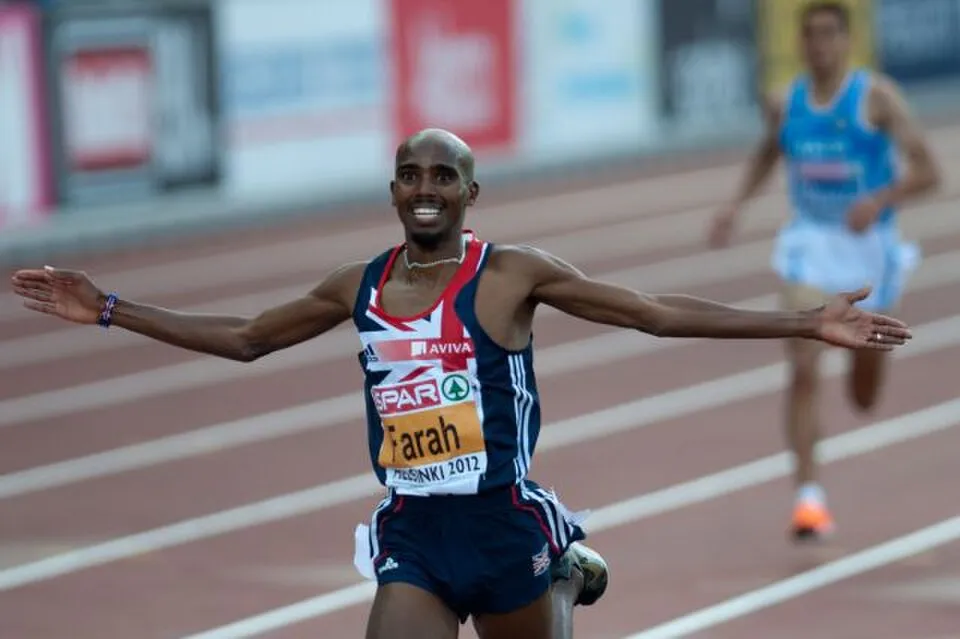
Farah became the first athlete ever to complete the Olympic distance-running double twice, winning both the 5,000m and 10,000m at London 2012 and Rio 2016. Four Olympic gold medals. Nobody had done it before, and nobody has matched it since.
His story started a long way from an Olympic stadium. Born in Somaliland, he arrived in Britain at eight years old, separated from his family and speaking almost no English. A PE teacher noticed he could run farther than everyone else.
The talent was obvious. Everything after that was built through years of disciplined training.
Here are the four habits that helped make Mo Farah one of the greatest distance runners in history.
Secret 1: 120-140 Miles a Week — The Volume That Built a Double Olympic Champion
After a disappointing 2008 Beijing Olympics, self-dubbed "the biggest setback of his career," Farah made a decision most athletes would never seriously consider.
He left his wife, his twin daughters, and his home in Britain, and moved to Kenya to train with the best distance runners in the world.
"I could easily have stayed in the UK with my family in a nice house, but I was willing to take a risk."
— Mo Farah
What he found in Kenya wasn't a secret technique or a revolutionary training method. It was something simpler and harder: an environment where elite performance was the only priority.
"They sleep, eat, train and rest, that's all they do. But as an athlete you have to do all those things."
— Mo Farah
Under that system, Farah began running 120 to 140 miles a week. Not occasionally. Consistently.
His training includes long runs to build aerobic base, tempo runs to raise the lactate threshold, and interval sessions to develop the finishing speed that defines championship racing. Twice a day, most days, with strength and conditioning layered on top.
His description of his Kenya setup was deliberately unglamorous:
"My room is basic: a bed, no TV. I wake up, run, have breakfast, sleep, gym in the afternoon, another run in the evening."
— Mo Farah
That simplicity was the point. No distractions and no decisions that didn't serve the training. Every hour of every day pointed in one direction.
"Don't dream of winning, train for it."
— Mo Farah
Arguably the important tool for anyone training for a long-distance race, isn't a shoe or a supplement, it's your very own data. A Garmin GPS running watch tracks pace, distance, heart rate, and recovery metrics across every session, giving you the same feedback loop elite coaches use to manage load and prevent injury. When you're building volume seriously, knowing the difference between a recovery run and a tempo run, and executing each at the right intensity like Farah, matters more than raw mileage.
Volume and consistency are the cornerstones of his training. Build your volume gradually, train smart, and let consistency do the heavy lifting. Stay the course.
Secret 2: Altitude Training — The Secret Weapon He Takes Home
Farah doesn't just train at altitude in Kenya and Ethiopia. When he's back in Britain at sea level, he brings the altitude with him.He sleeps in an altitude tent at home.
An altitude tent is exactly what it sounds like: a sealed enclosure that reduces the oxygen concentration inside, simulating the thin air of high-altitude environments. Spend eight hours sleeping inside one and your body responds much like it would at 8,000 or 10,000 feet by producing more red blood cells, improving oxygen transport, and increasing aerobic capacity. You wake up at sea level, but your body has spent the night adapting to altitude.
It's one of the more unusual tools in elite sport. It's also one of the most effective for endurance athletes.
The science is well established. At altitude, the body increases production of erythropoietin (EPO), a hormone that stimulates red blood cell production. More red blood cells means more oxygen delivered to working muscles, delaying fatigue and improving endurance. Farah's ability to unleash a finishing kick after 24 grueling laps depends, in part, on this aerobic advantage.
Another interesting tool in his training is an underwater treadmill. Running while partially submerged reduces the impact on joints and connective tissue, allowing him to log more miles without the same wear and tear.
An underwater treadmill isn't exactly practical for most people. The good news is that an altitude training sleep tent, however, is something you can actually use at home.
Research has shown that sleeping in a simulated high-altitude environment can stimulate the same physiological adaptations seen with altitude training, including increased red blood cell production and improved oxygen delivery. For endurance athletes looking for a legal performance edge, it's one of the few performance tools backed by decades of research.
It's quite literally training while you sleep.
Beyond sleep tents, Altipeak™ also produces simulated altitude generators and other hypoxic training systems suitable for people of all fitness levels to recreate high-altitude and improve cardiovascular health. They're designed for anyone looking to incorporate altitude exposure into their regular training program.
Secret 3: The 9pm Bedtime That Changed His Career
When Farah first moved in with elite Kenyan runners as a younger athlete, he noticed something that surprised him. They went to bed at 9pm. Every night. And they were up by 6am.
Farah on the other, at the time, was staying up until 2am. Seeing the benefits, he forced his self to adopt his Kenyan housemates' sleep schedule too.
He didn't ease into it. One night he simply started going to bed at 9pm, and remained consistent with it.
9pm; lights out.
The results were immediate enough that he credits the sleep shift as a turning point in his career, not just a lifestyle adjustment.
The energy he found from full sleep gave him the focus to believe he could compete internationally, not just domestically.
The science is straightforward. Sleep is when the body releases human growth hormone, rebuilds muscle tissue, consolidates motor patterns learned in training, and regulates cortisol. At 120-140 miles a week, the recovery demand is enormous. Farah gets 8 to 10 hours every night to meet it.
Getting enough sleep is only part of the equation. Knowing whether you're actually recovering is just as important.
A WHOOP recovery band tracks your sleep quality, heart rate variability (HRV), resting heart rate, and overnight recovery, helping you understand whether your body is adapting to training or simply accumulating fatigue. For endurance athletes, that feedback can be the difference between getting fitter and getting injured.
If you prefer something less intrusive, an Oura Ring offers many of the same recovery insights. Olympic champion Eileen Gu, another elite athlete who prioritizes sleep, has spoken about relying on her Oura Ring to monitor recovery. Choose whichever fits your lifestyle and budget.
One thing that benefits almost every athlete is a magnesium glycinate supplement. Magnesium plays an important role in muscle function, relaxation, and sleep quality. Yet, intense training and heavy sweating can deplete your body's stores. If you're constantly sore, cramping, or just looking for a natural everday sleep aid to improve your sleep quality, magnesium is one of the simplest supplements worth considering.
Secret 4: Fueling Like a Sports Car — The 25-Minute Recovery Window
One of Farah's former coaches put it in terms that stuck with him.
"You wouldn't own an expensive sports car and put poor fuel in it."
Farah applied that framing literally. His body is the car. The fuel has to match what the machine demands.
On a typical training day, he starts with a substantial breakfast around 30 to 40 minutes before his morning session. He's said that his stomach processes food quickly. That breakfast might be multigrain toast with jam and butter alongside a bowl of porridge and a large coffee.
Before a race, things shift. He loads up on chicken or salmon and rice, swaps to at least two large cups of coffee in the two to three hours before the gun.
He treats caffeine as a performance tool, not a habit.
Throughout the day, he eats small meals rather than three large ones. Pasta, rice, chicken, tuna, salad, vegetables are staples that keep his energy levels steady rather than spiking and crashing. He eats a serving of vegetables every day. He loves dark chocolate and makes no apology for it.
And then there's the 25-minute window.
The moment Farah finishes a hard training session, the clock starts. He gets a protein shake and a carbohydrate drink into his body within 25 minutes of finishing. He's spoken about this window specifically, calling it a non-negotiable part of his recovery.
The science backs the urgency: muscle glycogen replenishment and protein synthesis rates are both significantly higher in the first 30 minutes post-exercise than at any later point. Miss the window and you leave recovery gains on the table.
What he eats before training is almost beside the point compared to that window. He's even admitted to eating Frosties, the sugary cereal, before morning sessions when training in Britain. Fast energy in, fast energy available. Whatever works.
A high-quality fast-absorbing whey protein isolate is the most practical way to hit that 25-minute window consistently. Isolate digests faster than concentrate, which matters when the clock is ticking and a full meal isn't practical.
For the carbohydrate side of that post-run window, fast-release energy gels work well during long runs and can double as the carb component immediately post-session before a full meal. GU and Maurten are both used by elite runners and widely available.
Conclusion
Mo Farah's story is about a lot of things. Resilience, obviously. A refugee child who made it to the very top of one of sport's most demanding disciplines. The fall at Rio that he turned into a win with his daughter watching.
But underneath the story is a system. Enormous volume, managed carefully. Altitude exposure engineered into daily life. Sleep treated as a training session in its own right. A non-negotiable 25-minute post-run protein-shake and carbs feeding window.
Hard work. Relentless dedication and consistency. Non-negotiable routines. And an obsession with optimizing the little things, hour by hour, day after day, for years. That's what made Mo Farah one of the greatest distance runners the world has ever seen.
As we always say at Sixpack Snacks: if you want to be the best, practice the habits of the best.
Mo Farah's Essentials:
- Garmin GPS Running Watch (track pace, mileage, heart rate, and recovery across every run)
- Altitude Training Sleep Tent (simulate altitude while you sleep to support endurance adaptations)
- WHOOP Recovery Band (measure sleep quality and recovery between training sessions)
- Oura Ring (an alternative recovery tracker used by many elite athletes)
- Magnesium Glycinate (support muscle recovery and better sleep during heavy training blocks)
- Whey Protein Isolate (hit the 25-minute recovery window after hard sessions)
- Running Energy Gels (quick carbohydrates during long runs or immediately after training)
For more on what separates good athletes from great ones, read our breakdown of Leon Marchand's training secrets — including why the world's fastest swimmer credits 70% of his performance to mental preparation.
Sources
- Sweat Elite — Mo Farah's Diet and Nutrition
- Men's Fitness — Sir Mo Farah Interview: Olympics, Training and Nutrition
- Daily Routines — Mo Farah: Frosties for Fuel, 193km a Week
- Motley Health — Mo Farah Training, Fitness and Diet
- Altitude Dream — Three Secrets of Mo Farah's Training Regime
- Wikipedia — Mo Farah
- VICE Sports — Mo Farah Comes Back to Win After Falling at Rio
- Medium — Sir Mo Farah: A Remarkable Journey
- altitude training sleep tent
- Nature and Science of Sleep — Magnesium Bisglycinate Supplementation in Healthy Adults Reporting Poor Sleep: A Randomized, Placebo-Controlled Trial
This article is for informational purposes. Always consult a qualified coach, nutritionist, or medical professional before starting a new training or nutrition program.